All guides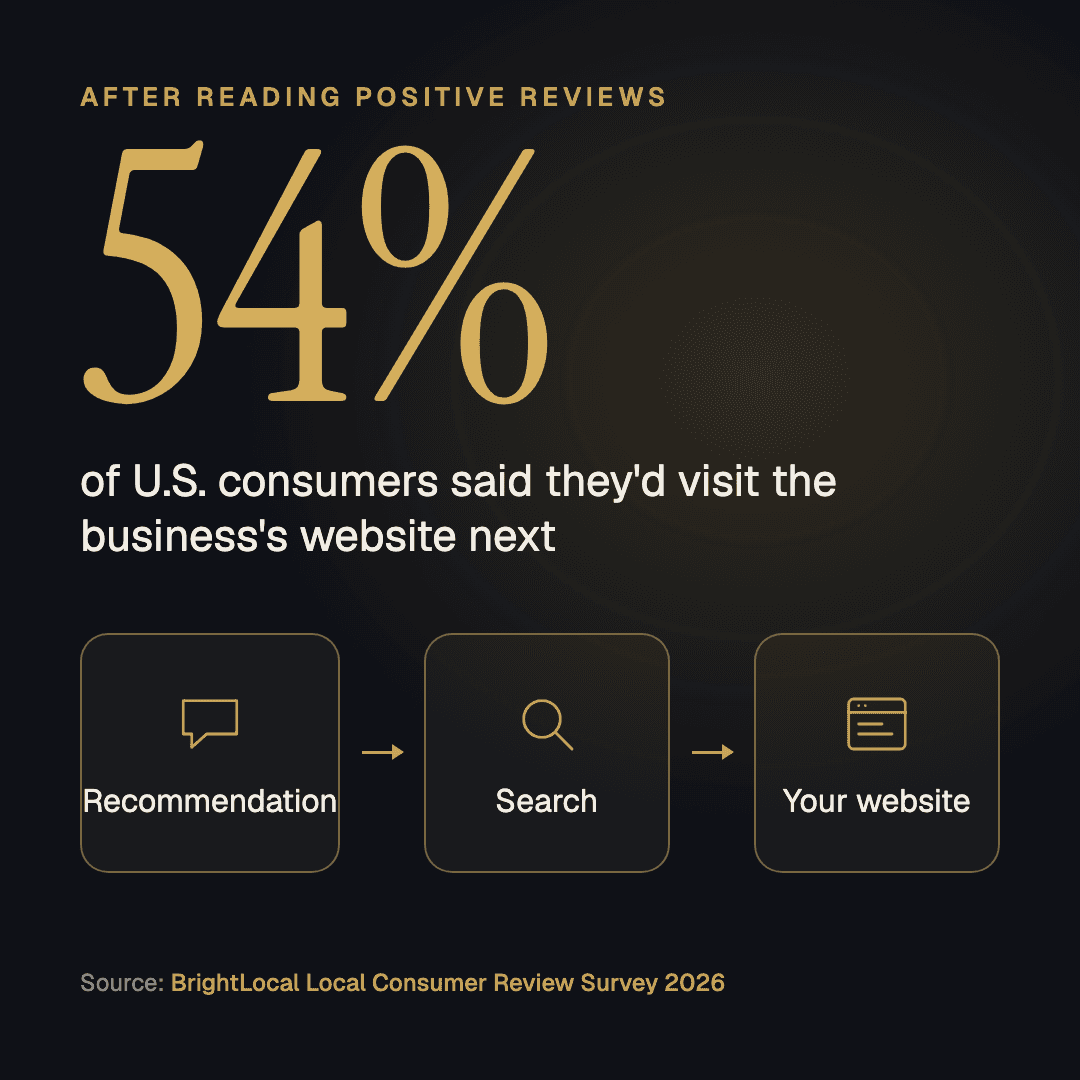
Word of Mouth Didn't Die: It Moved to Google
A lot of small businesses grew on referrals: one good job led to the next, and a happy customer told a friend, who told someone else. That still happens, though the step right after the recommendation looks different now.
Say a customer tells a coworker about the plumber who fixed their water heater. That evening the coworker types the plumber's name into Google, or asks ChatGPT, before picking up the phone. BrightLocal's 2026 Local Consumer Review Survey found that 97% of U.S. consumers read online reviews for local businesses, and that after reading positive reviews, 54% said they'd go on to visit the business's website. That was the most common next step, up from 32% when BrightLocal last asked in 2019. For a lot of referrals, what that quick search turns up has a real say in whether the recommendation becomes a customer.
What happens when the search finds nothing
If the search finds a clear, current website, the referral works the way your customer meant it to. The new person sees what you do, when you're open and how to reach you, and books. If it turns up nothing, or only a half-finished listing or a Facebook page nobody has touched in two years, some people will stop there and call whichever business did show up.
You won't hear about it, because nobody calls to say they couldn't find you. From your side it looks like the referral never happened.
The people doing this search already have a reason to like you. Someone they trust recommended you and the reviews they read were good, so they're checking before they commit.
If your customers speak Spanish
Recommendations travel through families and communities, and in many of them that happens in Spanish as well as English. When a customer passes your name along in Spanish, the person who hears it may search in Spanish too. If a real share of your customers speak Spanish, a Spanish version of your site lets the search end in the same language the recommendation started in.
People now ask AI for recommendations
People have also started asking AI tools such as ChatGPT, Google's AI Mode and Gemini to recommend local businesses, and that shift has been fast. In BrightLocal's 2025 survey, 6% of U.S. consumers said they'd used ChatGPT or another AI tool this way. In the 2026 survey it was 45%, which made AI tools, taken together, the third most-used source of local business recommendations after Google and Facebook, just ahead of Yelp (BrightLocal's 2026 AI report).
An AI tool can only recommend what it can find and read about. A business that exists only in people's memories and a few old social posts gives it little to go on. A plain website that says what you do and where, backed by a complete Google Business Profile and real reviews, gives it much more. Can ChatGPT find your business? goes into this in more detail.
What your website needs to answer
To help a referral land, your site has to answer the questions the new person has in the short time they give it:
- What you do
- Where you work
- When you're open
- What other customers say
- How to reach you or book
Write it in plain words so people, Google and AI tools can all read it, and keep it current, because an old phone number or last year's hours can undo a good recommendation.
That's what Experience Flows sells: sites written in plain language, in English and Spanish where it helps, kept current as part of a monthly plan, with online booking on our Growth and Premium plans. If you'd rather do it yourself, the list above is the same either way, and what a small business website really costs compares the options.
Ready to be found? Let's build it.
Whether you need a starter site today or a full managed build, the first conversation is free.